Tech Tree of the Web
The history of web technology, 1945 to now: 112 ideas and the lines between them. Drag, scroll or press ← → to travel. Open any one for its story.
World Wide Web, 1989. Era III, The Early Web.
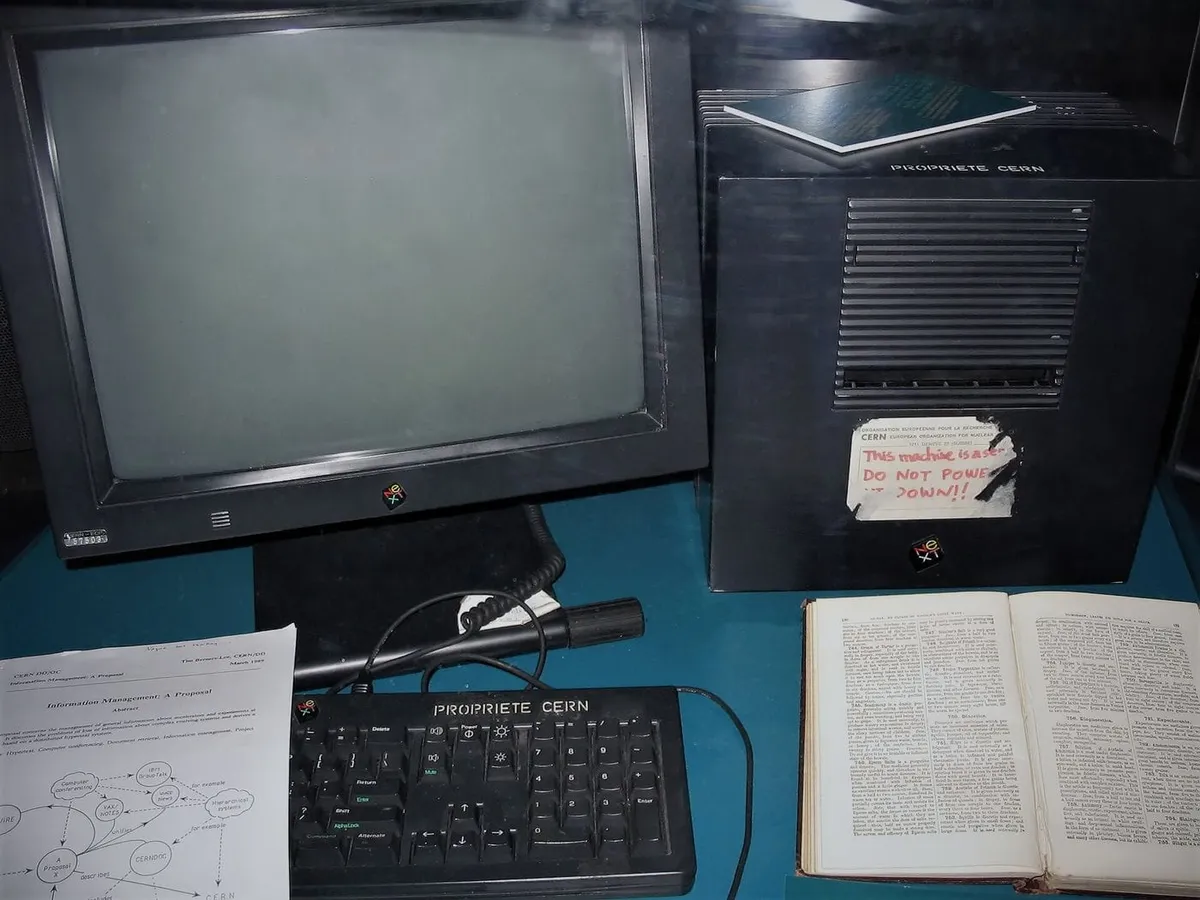
The NeXTcube Tim Berners-Lee used at CERN as the first web server, on display Coolcaesar (en.wikipedia), CC BY-SA 3.0
Key details
- When
- 1989 (proposal March 1989; first site 20 Dec 1990; public 6 Aug 1991)
- Who
- Tim Berners-Lee, with Robert Cailliau and Nicola Pellow, CERN
- Where
- CERN, Geneva, Switzerland
- Answered
- It answered the loss of information at CERN, where details of complex projects vanished with staff turnover or could not be found.
- Led to
- It led to the W3C, founded by Berners-Lee in 1994 after he moved to MIT, and a Web of 10,000 servers by the end of 1994.
World Wide Web
Joined hypertext to the internet so any document on any server could link to any other with one address scheme.
Facts
- The first website, holding the first pages describing the project, was published on 20 December 1990. 3
- On 6 August 1991, Berners-Lee posted a short summary of the project on the alt.hypertext newsgroup, inviting collaborators. 3
- Nicola Pellow wrote the line-mode browser during her student work placement at CERN. 1
- The first web server in the US came online in December 1991, at the SLAC particle physics lab in California. 1
- On 30 April 1993, CERN made the WorldWideWeb source code available on a royalty-free basis. 1
Quirks
- Mike Sendall, Berners-Lee's boss, wrote "Vague, but exciting" on the March 1989 proposal. 2
- The NeXT computer serving the first site carried a hand-written label in red ink: "This machine is a server. DO NOT POWER IT DOWN!!" 1
- Before choosing World Wide Web, Berners-Lee considered the names Information Mesh, The Information Mine, and Mine of Information. 3