Tech Tree of the Web
The history of web technology, 1945 to now: 112 ideas and the lines between them. Drag, scroll or press ← → to travel. Open any one for its story.
WebGL, 2011. Era V, The Platform.
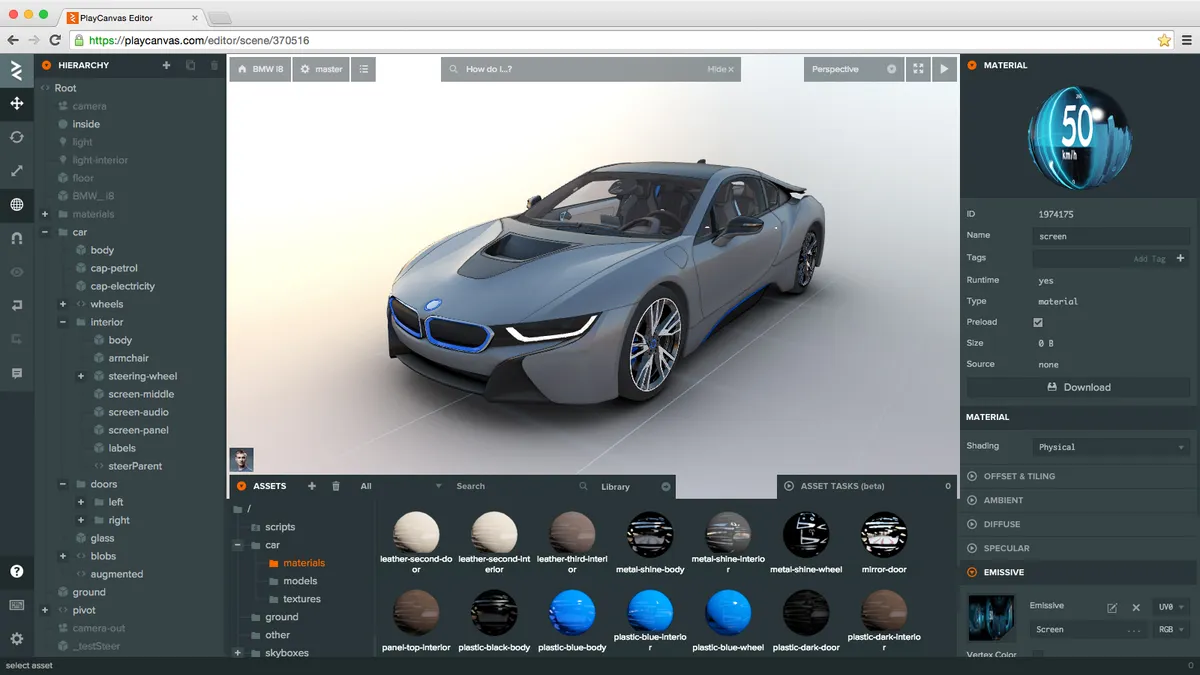
A 3D car model rendered live in a Chrome tab by the PlayCanvas editor, a WebGL engine: hardware-accelerated 3D drawn inside an ordinary web page. Maksims Mihejevs, CC BY-SA 4.0
Key details
- When
- 2011 (1.0 spec released 3 March)
- Who
- Vladimir Vukićević (Mozilla), Khronos Group WebGL Working Group
- Where
- Khronos Group; announced at GDC, San Francisco
- Answered
- It replaced plugins as the way to draw hardware-accelerated 3D graphics in a web page.
- Led to
- It led to WebGL 2.0 and then WebGPU, and gave browser ML libraries such as TensorFlow.js GPU access.
WebGL
Gave web pages direct access to the GPU through canvas, with no plugin.
Facts
- Vladimir Vukićević first demonstrated a Canvas 3D prototype in 2006, and Mozilla and Opera had separate implementations by the end of 2007. 1
- Khronos started the WebGL Working Group in early 2009. 1
- Khronos released the final WebGL 1.0 specification on March 3, 2011, at the Game Developers Conference in San Francisco. 2
- WebGL 1.0 defines a JavaScript binding to OpenGL ES 2.0. 2
- WebGL 2 was finished in January 2017, and on February 9, 2022, Khronos announced support in all major browsers. 1
Quirks
- Internet Explorer initially failed most of the official WebGL conformance tests. 1