Tech Tree of the Web
The history of web technology, 1945 to now: 112 ideas and the lines between them. Drag, scroll or press ← → to travel. Open any one for its story.
TCP/IP, 1974. Era II, The Network.
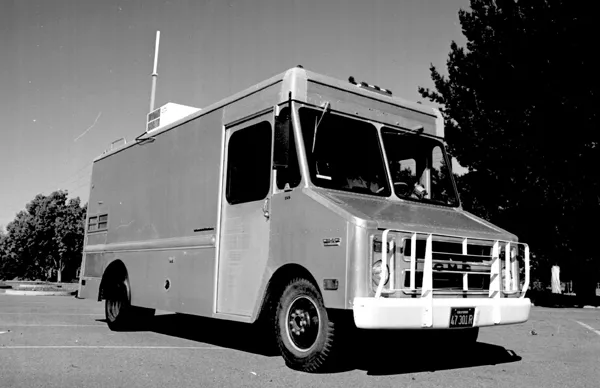
SRI's packet radio van, from which the first three-network TCP/IP transmission was sent in 1977. SRI International, CC BY-SA 3.0
Key details
- When
- 1974 (paper May 1974); ARPANET switch 1 Jan 1983
- Who
- Vint Cerf (Stanford) and Bob Kahn (DARPA); later Jon Postel
- Where
- DARPA and Stanford University
- Answered
- It answered the ARPANET's NCP host protocol with an open architecture that let separate networks interconnect.
- Led to
- It became the standard for US military networking in 1982 and the base protocol of the internet after the 1983 flag day.
TCP/IP
Let separate networks carry each other's packets with end-to-end reliability, the glue of a network of networks.
Facts
- Kahn introduced the idea of open-architecture networking shortly after arriving at DARPA in 1972, and asked Cerf to join in spring 1973. 2
- The first specification of the Transmission Control Program was written in December 1974 by Cerf, Dalal and Sunshine as RFC 675. 1
- A three-network test linked sites in the US, the UK and Norway in November 1977. 1
- In version 4, written in 1978, Jon Postel split the Transmission Control Program into separate TCP and IP protocols. 1
- The ARPANET completed its switch from NCP to TCP/IP on flag day, January 1, 1983. 1