Tech Tree of the Web
The history of web technology, 1945 to now: 112 ideas and the lines between them. Drag, scroll or press ← → to travel. Open any one for its story.
Single-page applications, 2010. Era V, The Platform.
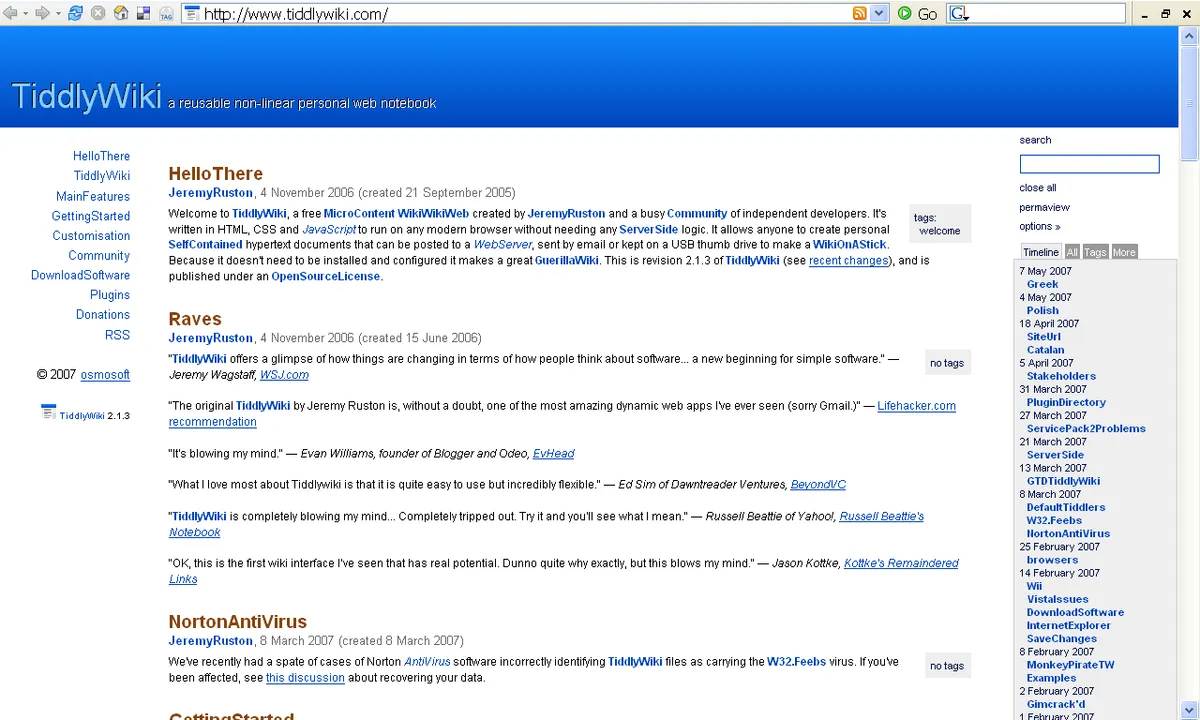
TiddlyWiki 2.1.3 in 2007, an early single-page application: a whole wiki in one HTML file whose JavaScript opens and edits entries without ever loading a new page. Osmosoft (TiddlyWiki), BSD
Key details
- When
- 2010 (Backbone.js 0.1.0, 13 October 2010)
- Who
- Jeremy Ashkenas (Backbone.js), DocumentCloud
- Where
- DocumentCloud
- Answered
- It gave structure to JavaScript-heavy pages that had grown out of Ajax techniques, using models, collections and views tied to a RESTful JSON API.
- Led to
- It was followed by frameworks such as AngularJS, Ember.js and React, and by browser history APIs like pushState.
Single-page applications
Gave client-side apps models, views and routing, so a page could load once and redraw itself from JSON.
Facts
- Backbone.js 0.1.0, the initial release, came out on October 13, 2010; version 1.0.0 followed on March 20, 2013. 2
- Backbone and Underscore.js were both extracted from the DocumentCloud codebase and packaged as standalone libraries. 2
- Backbone's only hard dependency is Underscore.js, and its production build is 7.9 KB minified and gzipped. 1
- Stuart Morris, a student at Cardiff University, built the self-contained site slashdotslash.com along single-page lines in April 2002. 3
- Google deprecated its hash-bang AJAX crawling scheme for indexing single-page apps in 2015. 3