Tech Tree of the Web
The history of web technology, 1945 to now: 112 ideas and the lines between them. Drag, scroll or press ← → to travel. Open any one for its story.
Perceptron, 1958. Era I, Antecedents.
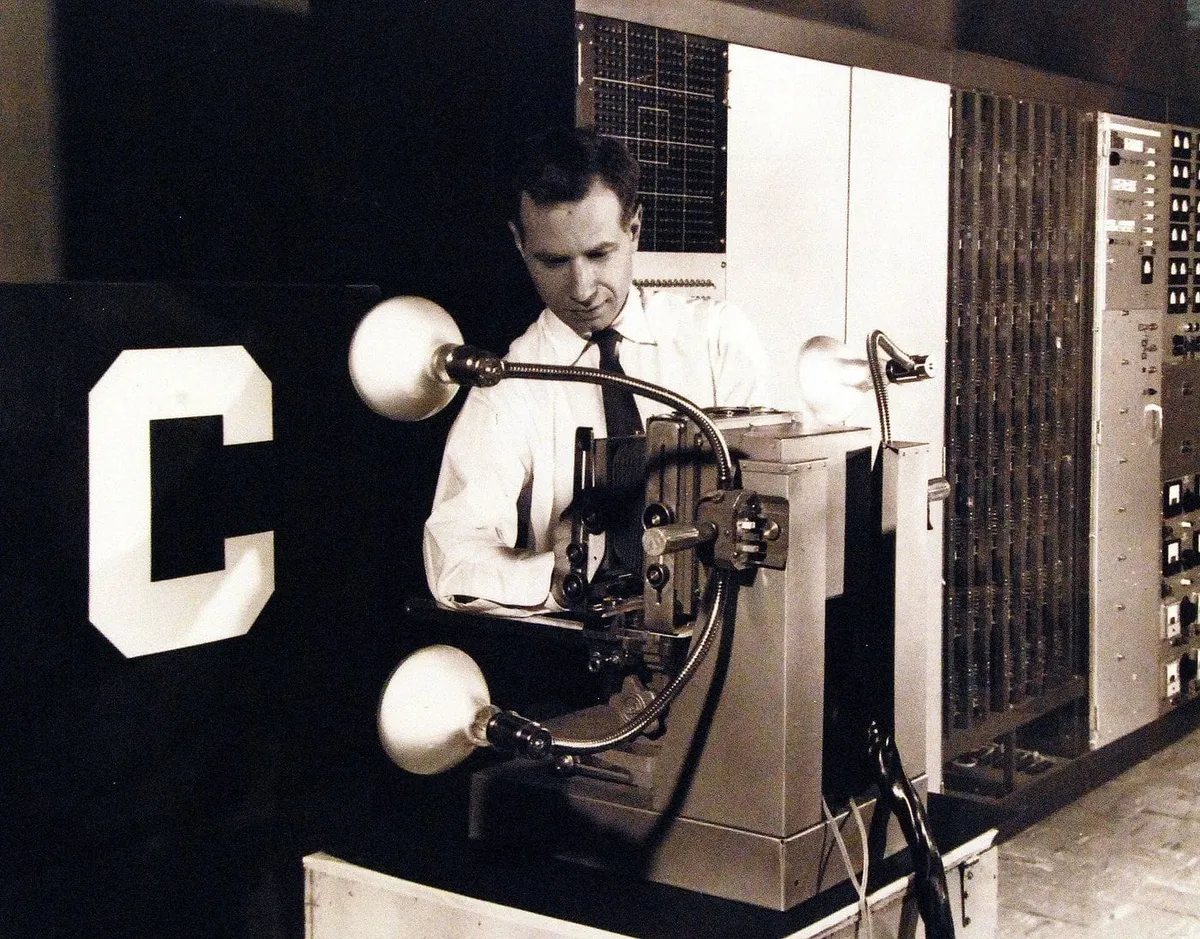
The Mark I Perceptron machine at Cornell Aeronautical Laboratory, released 1960 National Museum of the U.S. Navy, Public domain
Key details
- When
- 1958 (simulated 1957; Mark I demonstrated June 1960)
- Who
- Frank Rosenblatt
- Where
- Cornell Aeronautical Laboratory, Buffalo, New York
- Answered
- It answered hand-programmed pattern recognition with a machine that learned weights from examples.
- Led to
- It founded neural network research, which stalled after Minsky and Papert's 1969 critique and later revived.
Perceptron
Showed a machine could learn to classify patterns by adjusting connection weights from examples.
Facts
- In 1957 Frank Rosenblatt, at the Cornell Aeronautical Laboratory, simulated the perceptron on an IBM 704. 1
- The Mark I Perceptron used 400 photocells in a 20x20 grid, with weights stored in potentiometers and updated by electric motors. 1
- The Office of Naval Research funded the project, and the Mark I's first public demonstration was in June 1960. 1
- Minsky and Papert's 1969 book Perceptrons showed these networks could not learn the XOR function, contributing to a decline in neural network research. 1
- The Mark I was shipped from Cornell to the Smithsonian in 1967 and is in the National Museum of American History. 1
Quirks
- After a 1958 Navy press conference, The New York Times called the perceptron the embryo of a computer the Navy expected to walk, talk and see. 1