Tech Tree of the Web
The history of web technology, 1945 to now: 112 ideas and the lines between them. Drag, scroll or press ← → to travel. Open any one for its story.
Packet switching, 1964. Era I, Antecedents.
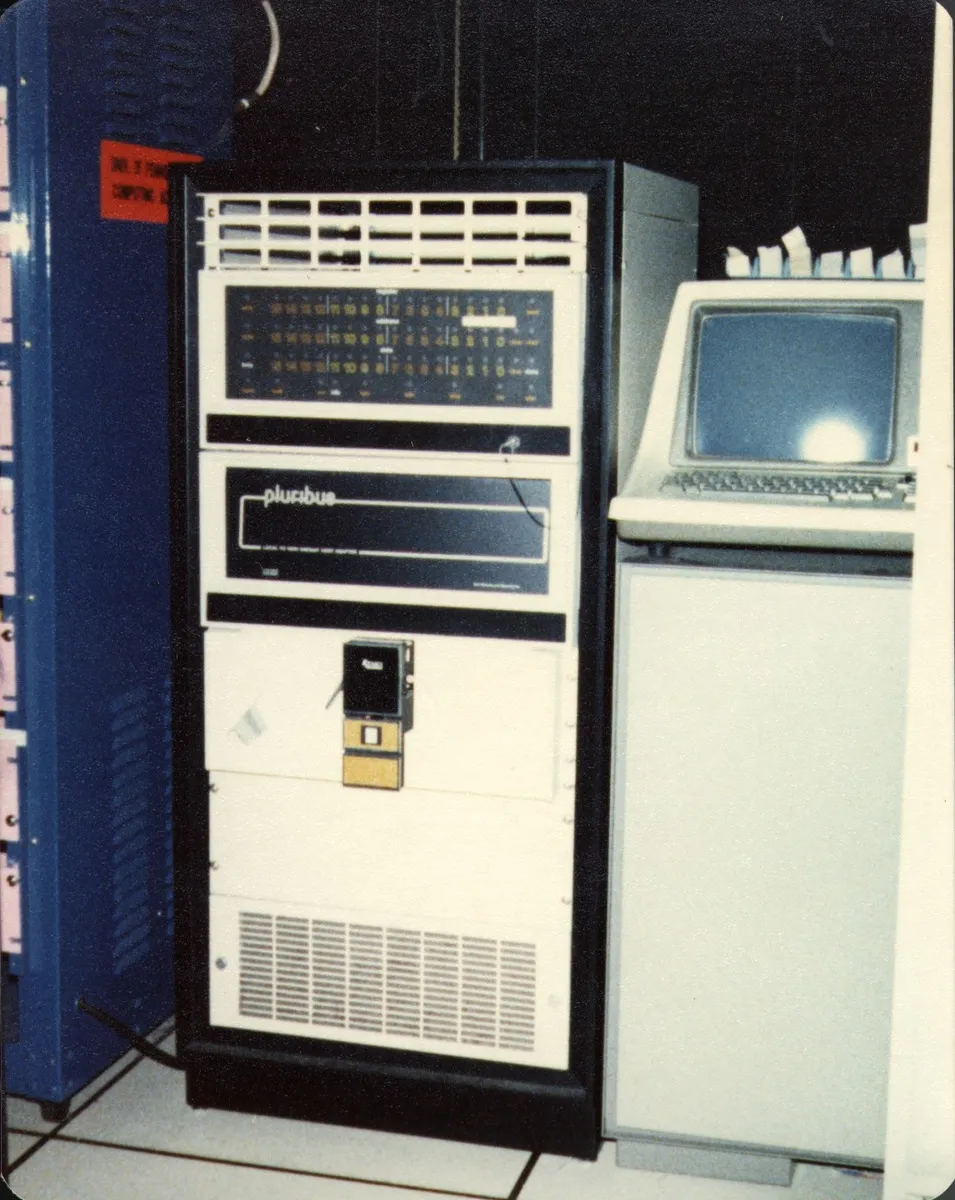
A BBN Pluribus, the multiprocessor packet switch built as a heavy-duty successor to the ARPANET IMP, installed at the Wharton School in 1979. Tony Patti, Public domain
Key details
- When
- 1964 (Baran's RAND reports); 1965 (Davies names packets)
- Who
- Paul Baran (RAND), Donald Davies and Roger Scantlebury (NPL)
- Where
- RAND Corporation, US; National Physical Laboratory, UK
- Answered
- It answered dedicated circuit switching with messages broken into blocks that share lines and are routed independently.
- Led to
- NPL's work persuaded Larry Roberts to use packet switching in the ARPANET, the forerunner of the internet.
Packet switching
Chopped messages into small addressed blocks that share lines and route around failures.
Facts
- At RAND, funded by the US Department of Defense, Baran developed a concept he called distributed adaptive message block switching. 1
- Baran's work appeared in 1964 in the RAND reports titled "On Distributed Communications". 1
- Donald Davies coined the term packet switching at NPL, and the NPL Data Communications Network began service in 1970. 1
- At an October 1967 conference, Roger Scantlebury of NPL proposed packet switching for use in the ARPANET. 1
- The Internet Society credits Leonard Kleinrock with the first paper on packet switching theory, published in July 1961. 2
Quirks
- The Internet Society says the ARPANET was never built to survive nuclear war; only the unrelated RAND study on secure voice considered it. 2