Tech Tree of the Web
The history of web technology, 1945 to now: 112 ideas and the lines between them. Drag, scroll or press ← → to travel. Open any one for its story.
Mercurial, 2005. Era IV, The Dynamic Web.
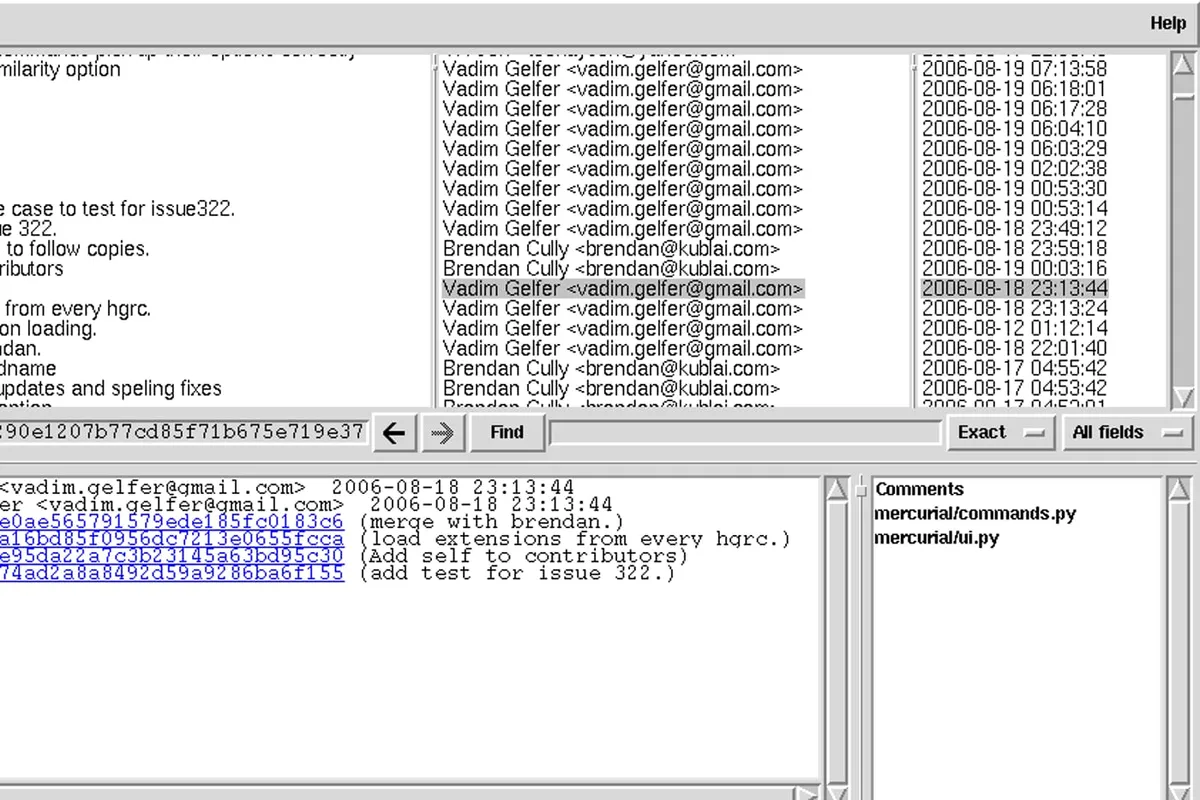
The hgk history viewer showing branching and merging changesets in Mercurial's own repository, 2006 Sebastian Goll at English Wikipedia, Public domain
Key details
- When
- 2005 (announced on linux-kernel 20 April)
- Who
- Olivia Mackall (then Matt Mackall)
- Where
- Linux kernel mailing list
- Answered
- It answered BitMover's withdrawal of the free version of BitKeeper earlier in April 2005.
- Led to
- It led to a distributed system used by Mozilla, Facebook and OpenJDK, though Bitbucket dropped it in 2020.
Mercurial
Offered distributed version control with a small, consistent command set, easy to extend in Python.
Facts
- Mackall announced Mercurial v0.1 as a minimal scalable distributed SCM, written in less than 600 lines of Python. 2
- The v0.1 post reported committing the Linux 2.6.10 kernel tree in 27 seconds and checking it out in 45 seconds on a laptop. 2
- Mozilla used Mercurial from 2007 and began moving to Git in 2023; Facebook adopted it in 2013 for its large monorepo. 1
- Bitbucket ended Mercurial support in mid-2020, saying fewer than 1 percent of new projects used it. 1
Quirks
- The command hg is the chemical symbol for mercury, and Mackall said the name also honored BitKeeper's Larry McVoy, whom she called mercurial. 1