Tech Tree of the Web
The history of web technology, 1945 to now: 112 ideas and the lines between them. Drag, scroll or press ← → to travel. Open any one for its story.
MapReduce, 2004. Era IV, The Dynamic Web.
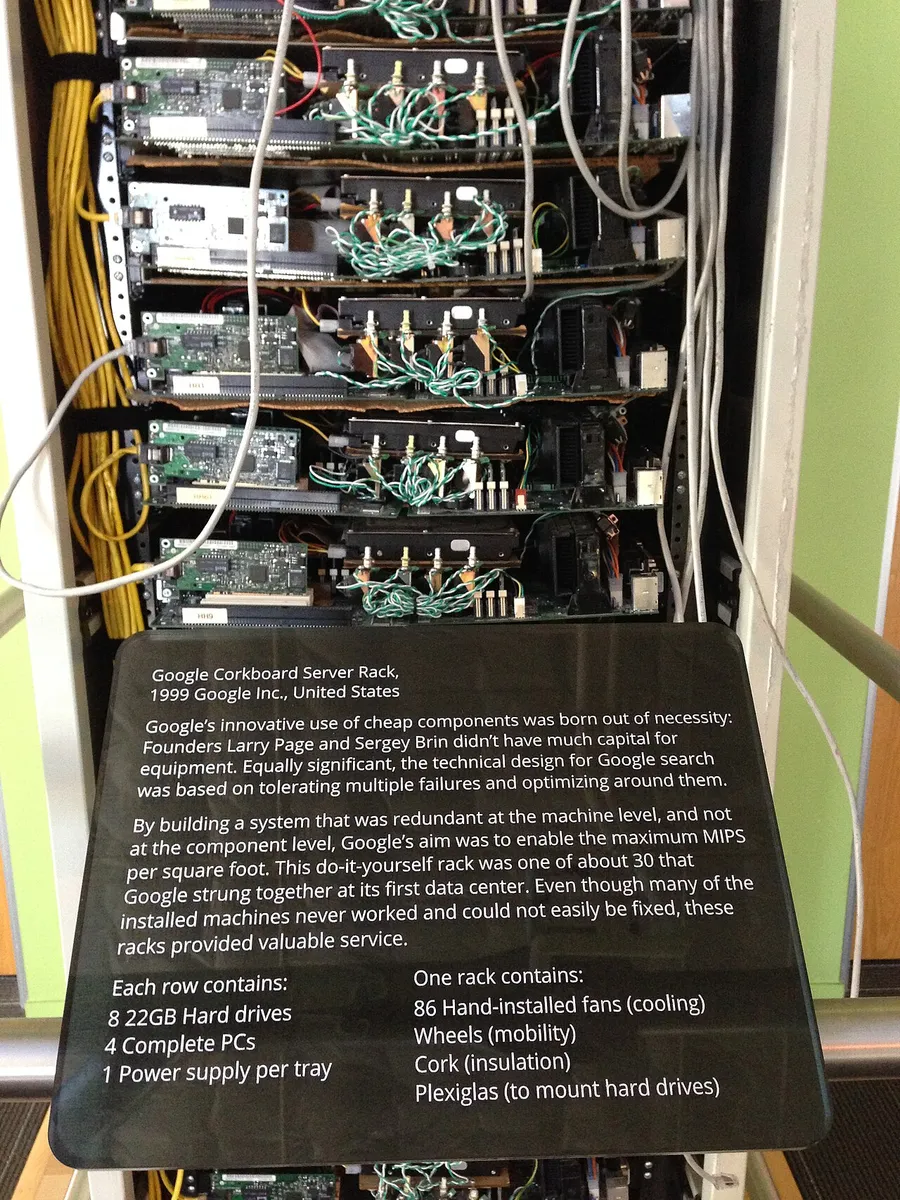
Google's 1999 corkboard server rack of cheap, failure-prone PCs, the kind of commodity cluster MapReduce was built to tame. Runner1928, CC BY-SA 3.0
Key details
- When
- 2004 (OSDI paper)
- Who
- Jeffrey Dean, Sanjay Ghemawat, Google
- Where
- Answered
- Google engineers had written hundreds of special-purpose distributed computations, each hand-coding parallelization, data distribution and failure handling.
- Led to
- Apache Hadoop and the big data ecosystem, and later Google systems such as FlumeJava and MillWheel.
MapReduce
Let programmers write two small functions and spread the work over thousands of cheap machines.
Facts
- Dean and Ghemawat said the abstraction was inspired by the map and reduce primitives of Lisp and other functional languages. 2
- The paper reported 29,423 MapReduce jobs at Google in August 2004, reading 3,288 TB of input. 1
- Rewriting Google's production indexing with MapReduce cut one phase from about 3,800 lines of C++ to about 700. 1
- A sort of about 1 TB of data on a cluster of roughly 1,800 machines finished in 891 seconds. 1
- By 2014 Google no longer used MapReduce as its primary big data processing model. 2