Tech Tree of the Web
The history of web technology, 1945 to now: 112 ideas and the lines between them. Drag, scroll or press ← → to travel. Open any one for its story.
LeNet convolutional networks, 1989. Era III, The Early Web.
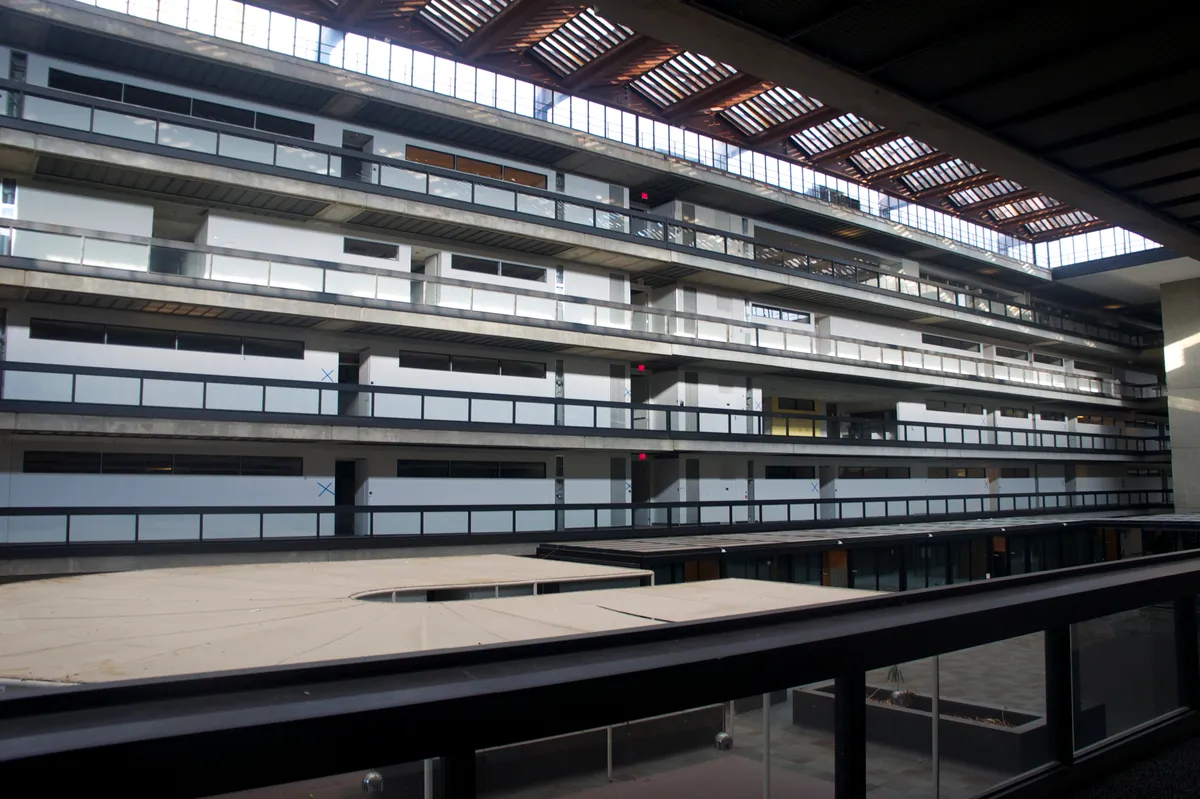
The atrium of the Bell Labs Holmdel building in New Jersey, where Yann LeCun's group developed LeNet. Lawrence Aberle, CC BY-SA 3.0
Key details
- When
- 1989
- Who
- Yann LeCun, with Lawrence Jackel, John Denker and colleagues at Bell Labs
- Where
- AT&T Bell Laboratories, Holmdel, New Jersey
- Answered
- It replaced hand-designed feature extractors with a convolutional network that learned features from pixels end to end.
- Led to
- It led to LeNet-5 and commercial check reading, and became the template for later convolutional networks such as AlexNet.
LeNet convolutional networks
Trained a convolutional network end to end to read handwritten zip codes, a template for vision models.
Facts
- The 1989 network was trained on 9,298 grayscale 16x16 images of handwritten ZIP codes from mail passing through a Buffalo, New York post office. 1
- It had about 9,760 independent parameters and took about three days to train on a Sun-4/260. 1
- It reached a 1% error rate with about 9% rejection; two humans tested on the same set averaged 2.5% errors. 1
- LeNet-5, published in 1998, had around 60,000 trainable parameters and was trained on MNIST. 1
- NCR deployed check-reading machines from June 1996; by 2001 they read an estimated 20 million checks a day, about 10% of US checks. 1