Tech Tree of the Web
The history of web technology, 1945 to now: 112 ideas and the lines between them. Drag, scroll or press ← → to travel. Open any one for its story.
HTTP/1.1, 1997. Era III, The Early Web.
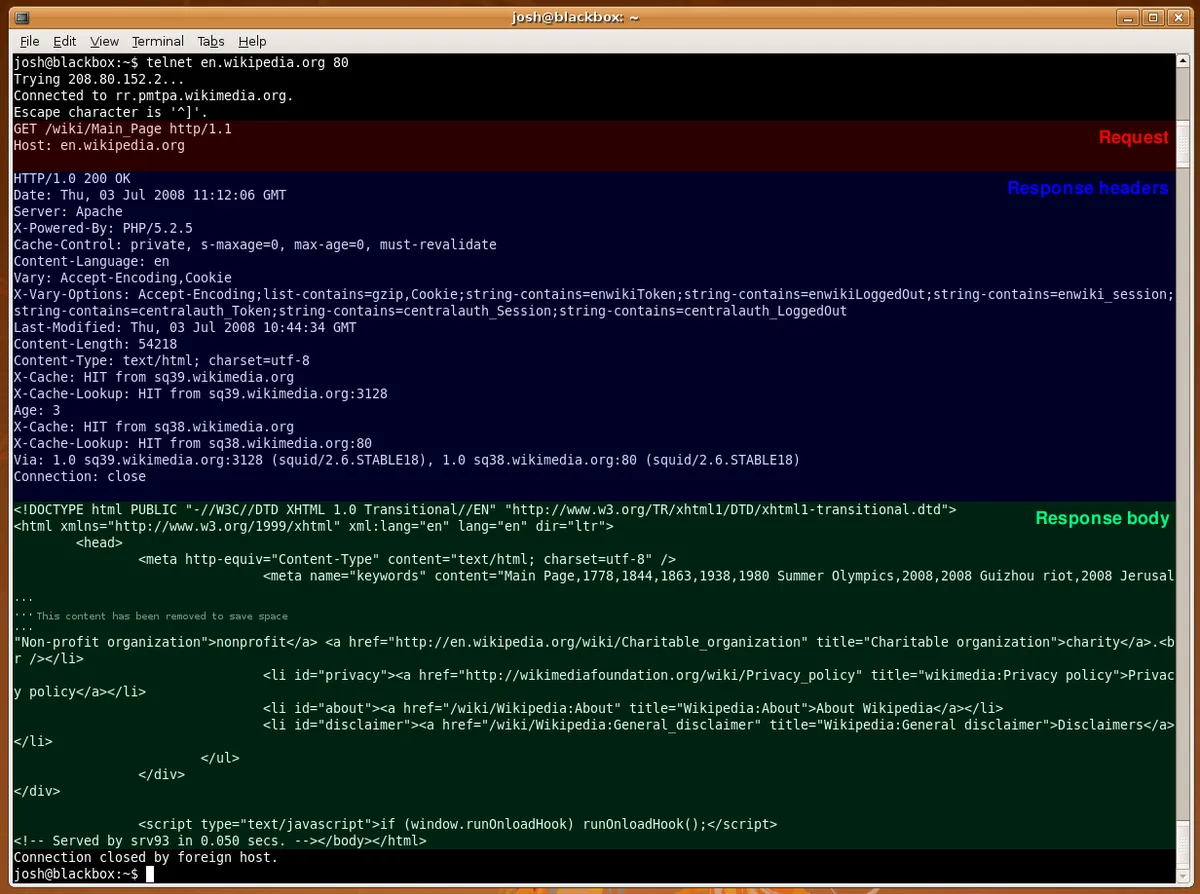
A raw HTTP exchange typed by hand over telnet: a GET request in HTTP/1.1 form with the Host header the 1.1 spec made mandatory, followed by Wikipedia's response headers and HTML. TheJosh, Public domain
Key details
- When
- 1997 (RFC 2068, January)
- Who
- Roy Fielding (UC Irvine), Jim Gettys, Jeffrey Mogul, Henrik Frystyk Nielsen and Tim Berners-Lee, IETF HTTP Working Group
- Where
- IETF
- Answered
- It answered HTTP/1.0's neglect of hierarchical proxies, caching, persistent connections and virtual hosts.
- Led to
- It was revised as RFC 2616 in 1999 and remained the web's main protocol until HTTP/2 arrived in 2015.
HTTP/1.1
Added persistent connections and the Host header, so one server and one IP address could host many sites.
Facts
- RFC 2068 was released in January 1997 as the HTTP/1.1 specification, a Proposed Standard. 1
- Under HTTP/1.1 a single connection may carry one or more request and response exchanges. 1
- The mandatory Host header distinguishes between DNS names sharing a single IP address, enabling name-based virtual hosting. 2
- All HTTP/1.1 applications must be able to decode chunked transfer coding, which streams content of unknown length. 1
- HTTP/1.1 was revised in RFC 2616 in June 1999, in six RFCs in June 2014, and as RFC 9112 in June 2022. 2
Quirks
- Request pipelining was never considered really safe because many servers and proxies mishandled it, and most browsers first disabled and then removed it. 2