Tech Tree of the Web
The history of web technology, 1945 to now: 112 ideas and the lines between them. Drag, scroll or press ← → to travel. Open any one for its story.
DOM and Dynamic HTML, 1998. Era III, The Early Web.
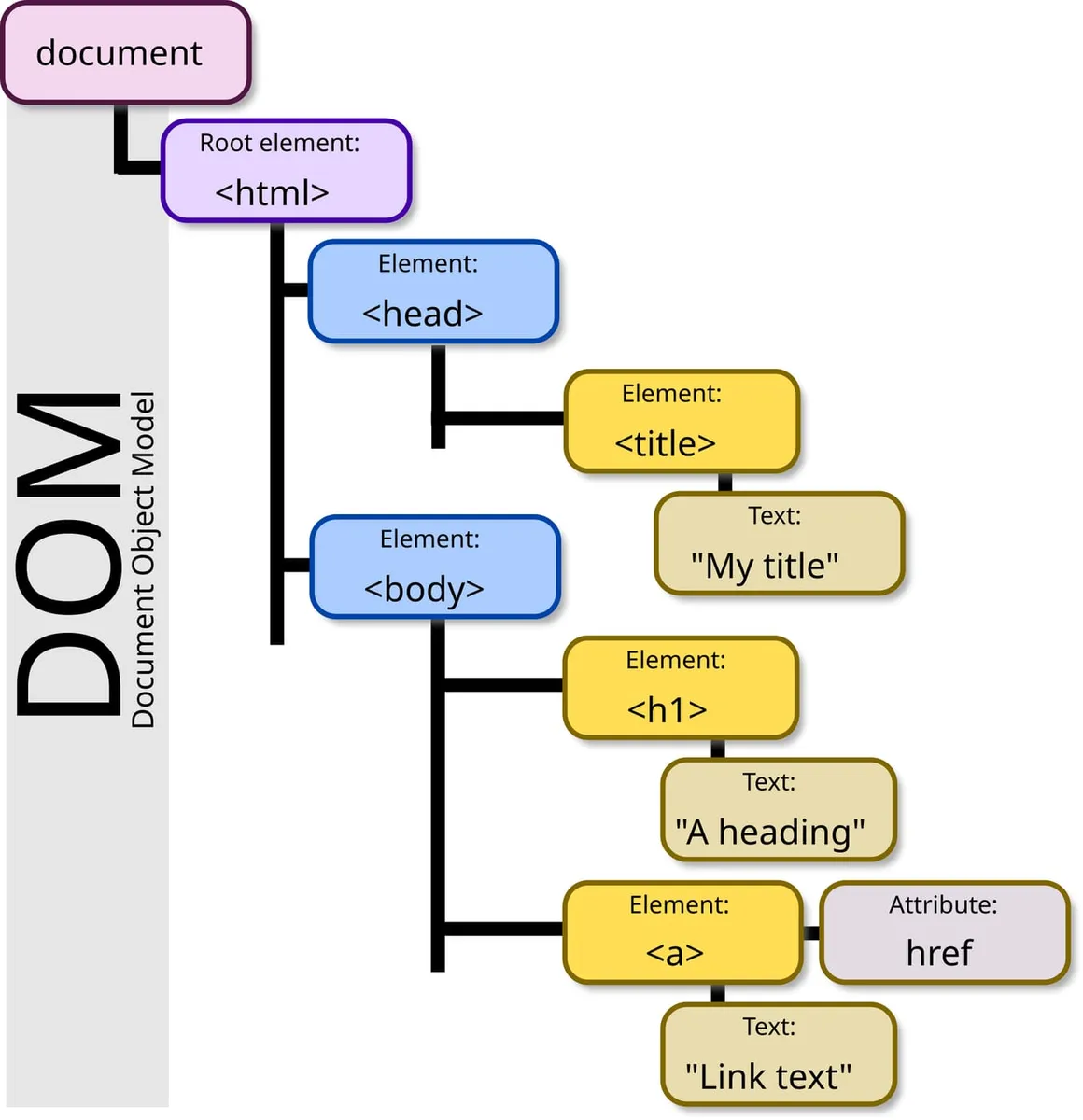
Tree diagram of the Document Object Model, from document down to individual elements and text Birger Eriksson, CC BY-SA 3.0
Key details
- When
- 1998 (DOM Level 1 Recommendation, 1 October 1998)
- Who
- W3C DOM Working Group chaired by Lauren Wood, with editors from Netscape, Microsoft, Sun, IBM and others
- Where
- World Wide Web Consortium (W3C)
- Answered
- It replaced the incompatible Dynamic HTML object models that Netscape Navigator 4 and Internet Explorer 4 built in parallel in 1997.
- Led to
- It led to DOM Level 2 in 2000, Level 3 in 2004, and the WHATWG DOM living standard from 2015.
DOM and Dynamic HTML
Exposed every element of a page as an object scripts could read and change while it was on screen.
Facts
- W3C published DOM Level 1 as a Recommendation on 1 October 1998. 2
- Its editors included Vidur Apparao of Netscape and Scott Isaacs and Chris Wilson of Microsoft, under Working Group chair Lauren Wood of SoftQuad. 2
- The spec has a Core part for any structured document plus XML extensions, and a separate HTML part. 2
- The DOM-like access in Netscape Navigator 2.0's JavaScript (1995) became known as DOM Level 0, and no independent standard was written for it. 1
- DOM Level 2 followed in late 2000 and DOM Level 3 in April 2004. 1